

Ghosts in the Machine: (Re)Constructing the Bodleian’s Index of Literary Correspondence, 1927–1963
With the first phase of our Project at an end and our second phase now well underway, it seems an appropriate moment to look back at our work thus far on EMLO and to return to the dataset that lies at its core: the ‘Index of Literary Correspondence’ in the Bodleian Library, a card catalogue which occupies an imposing set of wooden filing drawers at the ‘Selden End’ of the Duke Humfrey’s Reading Room.
This remarkable free-standing resource, describing a significant percentage of Bodley’s rich holdings of sixteenth-, seventeenth-, and eighteenth-century correspondence, had been accessible until recently only to those working on-site; as per our brief, it has been scanned and digitised, and now its 48,691 unique records can be searched and browsed online within EMLO, radically improving the discoverability and manipulability of the cards and the letters to which they refer. However, until now, we have known nothing about the creation of the analogue card index beyond a farrago of hearsay, local anecdote, and library lore; those who compiled the records, and the intellectual principles on which they, and their supervisors, operated, were proving elusive. This frustrated both our attempts to understand and appreciate the overall shape of the catalogue in terms of what is and is not included, as well as our efforts to credit those epistolary Stakhanovites on whose painstaking work our digital effort has depended.
We are pleased, therefore, to be able to share a near-complete narrative of the genesis and evolution of the card index, based on completely fresh archival research.[1. For leads and information on the individual cataloguers, I would like to thank in particular Bruce Barker-Benfield, Mary Clapinson, Wilma Minty, and David Vaisey; had it not been for a tip from Bruce, we might never have known of the existence of their working notebook. Thanks are due also to Colin Harris and his team of helpful staff in the Bodleian’s Special Collections, in particular to Vicky Saywell, and to Project colleagues past and present — Philip Beeley, Howard Hotson, Kim McLean-Fiander, Leigh Penman, and Richard Sharpe — for their input, expertise, and comments on drafts. Our Digital Project Manager James Brown supervised my research and helped shape the piece, especially the introductory and concluding sections on library history. Every archivist I have approached regarding our cataloguers has provided efficient and informed assistance: thanks especially to Sian Astill at the Oxford University Archives; Suzanne Foster, archivist of Winchester College; Katherine Phillips at the Imperial War Museum, London; and Anna Sander, archivist of Balliol College, Oxford. Most of all, I would like to thank Professor Julian Hunt for responding to an email which arrived out of the blue and for providing a wealth of information about his grandfather — without him it might not have been possible to identify for certain the man who has made the greatest contribution of all — and Christopher Legge for sharing his childhood and family memories.] The pursuit of such questions is not only of local, antiquarian, or Project interest; the recent archival (or technical) turn across the humanities and social sciences, now manifesting in conferences and research networks, has established repositories not only as sites for research but also as ‘fascinating objects of study’ in their own right.[2. Randolph C. Head, ‘Preface: historical research on archives and knowledge cultures: an interdisciplinary wave’, Archival Science, vol. 10, issue 3 (Sept. 2010), pp. 191–4.] It is recognised now that the ‘material conditions, infrastructures, and mediations’ of archives have a constitutive role in knowledge production,[3. See Ben Kafka, ‘From the Desk of Roland Barthes’, published online: 10 February 2011.] with cataloguing practices in particular shedding light on the intellectual ambitions of organisation within particular institutional contexts, and influencing the discoverability of documentary objects, and — in turn — the kinds of histories which ultimately can be made.
Indeed, the card catalogue itself — direct descendent of ‘Harrison’s Indexes’ (as described by intelligencer Samuel Hartlib)[4. Noel Malcolm, ‘Thomas Harrison and his “Ark of Studies”: An Episode in the History of the Organization of Knowledge’, The Seventeenth Century, 19, no. 2, pp. 196–232.] and linchpin of repositorial efforts to marshal ‘stuff about stuff’ since the early twentieth century — has recently been given monographic treatment in Marcus Krajewski’s Paper Machines, an excellent sociology of card index technology which traces its journey from scholarly experiments in early modern Europe to the libraries and archives of the twentieth century via the French Revolution and corporate America.[2. Markus Krajewski, Paper Machines: About Cards and Catalogs, 1548–1929 (Cambridge, MA, 2011).] Krajewski figures these durable workhorses as ‘universal discrete machines’, [3. Krajewski, p. 3.] but they were of course populated by human hands within specific archival ecosystems. By cross-referencing curatorial documents with the Bodleian’s reports and records, we have reconstructed these processes for the Library’s epistolary card index, and are able at last to tell this catalogue’s story while contributing a small footnote to the history of information science.
The creation of the ‘Index of Literary Correspondence’ took place across three distinct phases, falling between 1927 and 1963, and mapping on closely in each case to changes in senior management within the Library.
These can be described in turn:
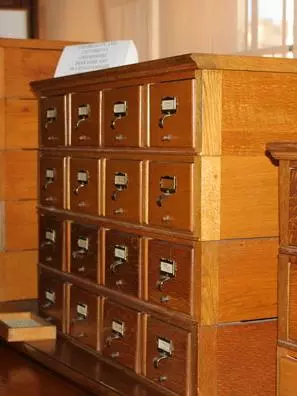
Wooden Worlds: The Bodleian’s iconic ‘Index of Literary of Correspondence’, pictured in situ at the so-called ‘Selden End’ of Duke Humfrey’s Library. Previously available only on-site, it is now one of the core datasets in Early Modern Letters Online.
Indexer: Kate Muriel Pogson (1888–1968)
Work began on the index in 1927. The Annual Report of the Curators for this year states: ‘The Bodleian is especially rich in original correspondence of English Literary men between 1650 and 1750. An index of writers and recipients of letters in the more important collections has been commenced by Miss Pogson, who has indexed MSS Rawlinson letters 1–3 (about 500 letters to Thomas Hearne)’.[2. ‘Annual Report of the Curators of the Bodleian Library for 1927’, Oxford University Gazette (7 March 1928), p. 394.] It is likely the project was initiated by Edmund Craster, for whom the position of Keeper of Western Manuscripts had been created that same year, and the choice of Hearne as a starting point is not surprising; the antiquarian and diarist was a figure of particular interest in early twentieth century Oxford, with the Oxford Historical Society’s eleven-volume edition of his life and works reaching its conclusion in 1921.[3. Remarks and Collections of Thomas Hearne, 11 vols (Oxford Historical Society, 1885–1921).]
The staff member assigned to the work was Kate Muriel Pogson, a former post office clerk who joined the Library in 1913.[4. Miss Pogson’s dates of employment at the Library are given in the notice of her resignation, ‘Annual Report of the Curators of the Bodleian Library for 1939–40’, Oxford University Gazette (11 December 1940), p. 160. In 1906, a Kate Muriel Pogson is recorded as working as a Clerk for the Post Office; see The London Gazette (1 June 1906), p. 3858.] She was was one of a number of female staff members recruited by Edward Williams Byron Nicholson (Bodley’s Librarian, 1882–1912) and his successor Falconer Madan (Librarian, 1912–1919) in connection with the ongoing revision of the main author catalogue.[4. See Edmund Craster, History of the Bodleian Library 1845–1945 (Oxford, 1952), p. 258.] Following the onset of war, Pogson had been transferred temporarily to Finance, replacing R. A. Abrams, a Senior Assistant who left for the front[5. ‘Annual Report of the Curators of the Bodleian Library for 1915’, Oxford University Gazette (3 May 1916), p. 440, and The Bodleian Quarterly Record (July 1915), p. 145. Abrams was killed in action, 4 March 1917; see entry for ‘Abrams, Reginald Arthur’, in The Register of the City of Oxford High School, ed. E. A. Bowen (privately printed, n.d.) p. 73, and the obituary in The Bodleian Quarterly Record, vol. ii, no. 13, 1st quarter (1917), p. 6.] — a role she seems to have retained — where she was praised for her meticulous work[6. ‘Annual Report of the Curators of the Bodleian Library for 1917, (n.d.), p. 7.] (which included preparing ‘a digest of the Accounts of the Library from the earliest times and finished it for the periods 1613–1670, and 1882–1918’),[7. ‘Annual Report of the Curators of the Bodleian Library for 1918′, Oxford University Gazette (26 February 1919), p. 302. Madan published — posthumously — in The Bodleian Quarterly Record a two-part ‘Survey of Bodleian Library Finance’, of which Part I, from 1320 to 1660, appeared in vol. viii, no. 85, 1st quarter (1935), pp. 6–15, with Part II covering 1660–1881 following in vol. viii, no. 86, 2nd Quarter (1935), pp. 55–65; this appears to be based on Pogson’s data.] and in the early 1920s she produced several articles based on the Bodleian’s epistolary holdings.[8. K.M.P., ‘Lord Howard of Effingham’, The Bodleian Quarterly Record, vol. iii, , no. 28, 4th quarter (1920), pp. 77–8; K.M.P., ‘The Wanderings of Apollonius’, The Bodleian Quarterly Record, vol. iii, no. 31, 3rd Quarter (1921), pp. 152–3; K.M.P., ‘A Grand Inquisitor and his Library’, The Bodleian Quarterly Record, vol. iii, no. 34, 2nd Quarter (1922), pp. 239–44.] She would have been a natural choice, therefore, for the new enterprise.
From 1927, Pogson worked on indexing the Hearne letters in the Rawlinson manuscripts, and from 1929 with the ‘assistance of Mr. H. W. Alderman … the correspondence of Thomas Rawlins (1723–49) contained in six volumes of the Ballard collection’, carefully recording her progress and queries in a dedicated notebook, which survives in the Library’s archives.[9. Bodleian Library, Oxford, Library Records d. 1734, ‘Notes re. index to literary corresp.’ (1950s).] It appears that, at the outset, her brief was to record no more than ‘writer and date’,[10. See ‘Annual Report of the Curators of the Bodleian Library for 1928’, Oxford University Gazette (13 March 1929), p. 416.] but the scope of the exercise expanded in 1929 when the Reverend H. E. Salter (editor of the penultimate three volumes) donated of a set of printed sheets from the Hearne edition to be cut up and pasted onto the relevant typed cards to form thematic abstracts,[11. ‘Annual Report of the Curators of the Bodleian Library for 1929’, Oxford University Gazette (5 March 1930), p. 398.] and it would appear that Pogson — in a characteristic manoeuvre for those at the cataloguing coalface[17. Krajewski, p. 73.] — returned thus to enhance her earlier records (see, for example, the card for Rawl. Lett. 1., fol. 1, illustrated above).
Pogson did not continue on the project beyond 1931, when the Annual Report of the Curators records bluntly that ‘work on the index of Hearne’s correspondence was suspended during the year’.[12. Annual Report of the Curators of the Bodleian Library for 1931’, Oxford University Gazette (11 May 1932), p. 529.] The circumstances surrounding this abrupt discontinuation of the project after just four years of work are unknown, but it is possible that, as horizons expanded beyond Hearne to encompass the full wealth of the Bodleian’s early modern letter holdings and the creation of abstracts, Pogson’s paleographical skills might have been stretched beyond their limit. Changes in library management were likely also to have played a part: in 1931 Edmund Craster was promoted to the post of Bodley’s Librarian, while his successor as Keeper of Western MSS (a scholar of Ancient Greece called Edgar Lobel) may have had different curatorial priorities.
Little more is heard of Pogson in official records until her resignation in 1939.[13. ‘Annual Report of the Curators of the Bodleian Library for 1939–40’, Oxford University Gazette (11 December 1940), p. 160.] She never married, and died in Sussex at the age of eighty in 1968. On her death certificate, the occupation stated is simply ‘Librarian’.[14. Miss Kate Muriel Pogson of Lilac Cottage, Alfriston, Sussex, spinster, died on 15 March 1968, aged eighty. See The London Gazette (29 March 1968), p. 3855; and G.R.O. Certificate of Death: Kate Muriel Pogson, date of death 15 March 1969 (Filed 18 March 1968), Hailsham, East Sussex, No. 313.]
Conclusions: Ghosts in the Machine
A blog post is not the place to elaborate a full range of conclusions emerging from this brief case study — although a second installement will follow in which I intend to consider exactly what was catalogued when, as well as which manuscripts were not selected for inclusion — but what is perhaps most interesting about the creation of the Bodleian’s Index of Literary Correspondence is its ad hoc, iterative, and almost casual nature. It was compiled, piecemeal, by enthusiastic and talented amateurs and its progress over thirty-five years was characterised by false starts, abrupt changes of direction, moments of disruption and caesura, and luck. Whilst tied intimately to changes within the Library prefecture, supervision of the project appears generally to have been light; there was no attempt to standardise ontologies between each of the three phases, and it seems that even those Keepers who took the liveliest interest in the enterprise (Craster and Richard Hunt) may have guided the indexers orally rather than providing extensive formal written instructions and schedules for data-capture.
Inevitably this has implications for the functioning of our particular paper machine, and those who have explored the index either in situ or in the context of EMLO will have encountered idiosyncracies that would not exist in more ruthlessly professionalised resources. It is also highly selective; the ‘euphoria of totality’ engendered by card catalogues is misleading in this case, as a significant number of the Bodleian’s epistolary guardbooks were not included, reflecting the intellectual predilections of both indexers and directors (as in the initial focus on Hearne). In all these senses, the index perhaps bears (in Krajewski’s phrase) closer relation to a subjective and personally generated ‘scholar’s machine’ (or learned excerpt collection) than a conventional institutional catalogue (the latter a sort of universal search engine ‘designed to register everything randomly’), problematising this hard and fast distinction between the two kinds of resource.[35. Krajewski, p. 50.]
These eccentricities notwithstanding, the Index of Literary Correspondence is a sensationally interesting and useful resource, and — in line with the general electrification of libraries — lives on in its new incarnation within the digital realm of EMLO, forming the core around which our virtual machine will grow. Not only are its records now freely available to users worldwide and more siftable and discoverable than ever before — the mobile carriers of the card catalogue find their logical extension in the online relational database — but we have used EMLO’s powerful editorial environment (much more flexible than anything enjoyed by our predecessors) to link them to an ever-wider range of cognate records and resources, and to deal sympathetically with some of the peculiarities of the catalogue likely to be most frustrating to the modern user, in particular the wildly divergent expression of proper nouns (which we have standardised and de-duplicated using our merging toolset).
Alongside these new digital impulses, we have tried to preserve the integrity of the paper machine, not least by reproducing in the front-end scanned images of the original index cards alongside the cleansed metadata. In a very real sense, the Project’s digital work on the index since 2010 has been a triangulation between ourselves, the senders and recipients of the letters being catalogued, and — it turns out — just three indexers, to whom now we are delighted to be able to give names and stories.